Artificial intelligence in contact center operations is transforming these departments from reactive, cost-focused units into proactive hubs that drive revenue and enhance customer experiences. With ai call center solutions for the next era of business, companies can manage routine inquiries more efficiently, support agents to perform at their best, and deliver consistent, high-quality service. Future-proofing customer service with AI in call centers ensures organizations are ready for the evolving expectations of customers and the challenges of modern business.
AI in contact centers is most effective when paired with cloud computing platforms for flexible, scalable service management, enabling businesses to process high volumes of customer interactions and access data securely from anywhere. Using advanced analytics and big data insights through modern IT infrastructure allows contact centers to uncover trends, anticipate customer needs, and deliver tailored experiences. This technological foundation also supports AI-driven financial tools for smarter decision-making, helping companies automate reporting, detect irregularities, and optimize budgeting and investment strategies.
AI’s benefits extend to digital marketing powered by intelligent customer behavior analysis, where organizations can create personalized campaigns, boost engagement, optimize marketing spend, and strengthen online brand presence. By leveraging cloud-based analytics and AI-enhanced marketing platforms for targeted customer outreach, businesses gain a unified view of audiences, enabling smarter content delivery and more effective campaign results.
By integrating artificial intelligence in contact center operations with modern cloud technology, scalable IT infrastructure, predictive financial solutions, and AI-powered marketing systems, companies can build a connected ecosystem where customer service, business intelligence, and marketing efforts work seamlessly together. This guide explores what AI in the contact center truly means, the technologies that enable it, the business outcomes it can produce, and actionable steps to implement it for measurable success.
Top 10 Contact Center Solutions for Artificial Intelligence in Contact Center Operations
In today’s competitive business environment, artificial intelligence in contact center operations is transforming how companies interact with customers, improve efficiency, and drive growth. Here is a list of top contact center solutions that leverage AI to optimize customer service, streamline workflows, and provide actionable insights.
1. Bright Pattern
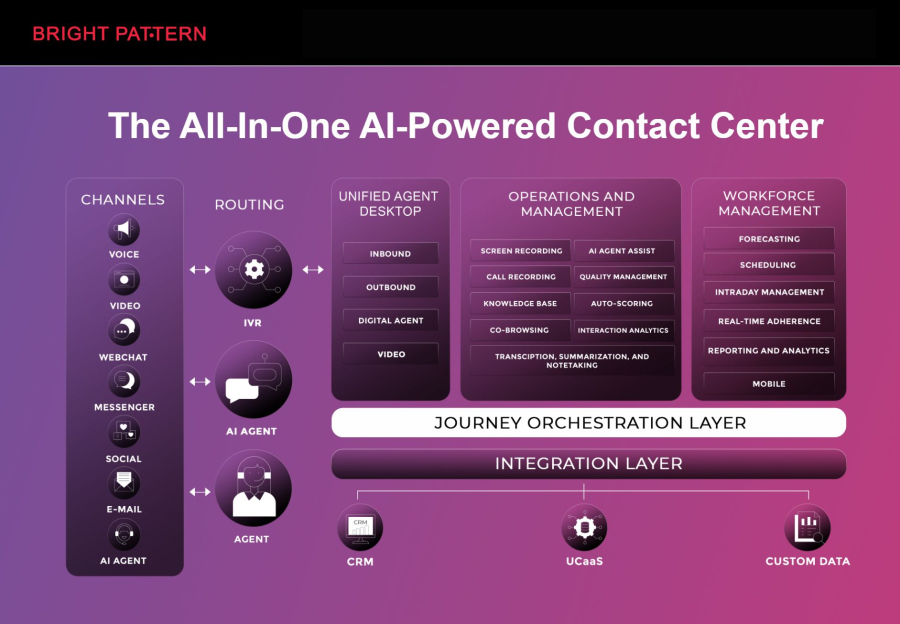
Bright Pattern stands out as a leading provider of AI contact center solutions designed to improve customer experience and agent productivity. Their platform combines omnichannel communication, cloud deployment, and AI-driven automation to create a seamless support ecosystem.
Key features of Bright Pattern include:
- Omnichannel routing for voice, chat, email, SMS, and social media interactions
- AI-powered virtual agents to handle routine queries and free up human agents for complex issues
- Real-time analytics and reporting to monitor performance and optimize workflows
- Integration with CRM systems and other business tools for a unified customer view
- Cloud-based infrastructure for scalable, flexible deployment across multiple locations
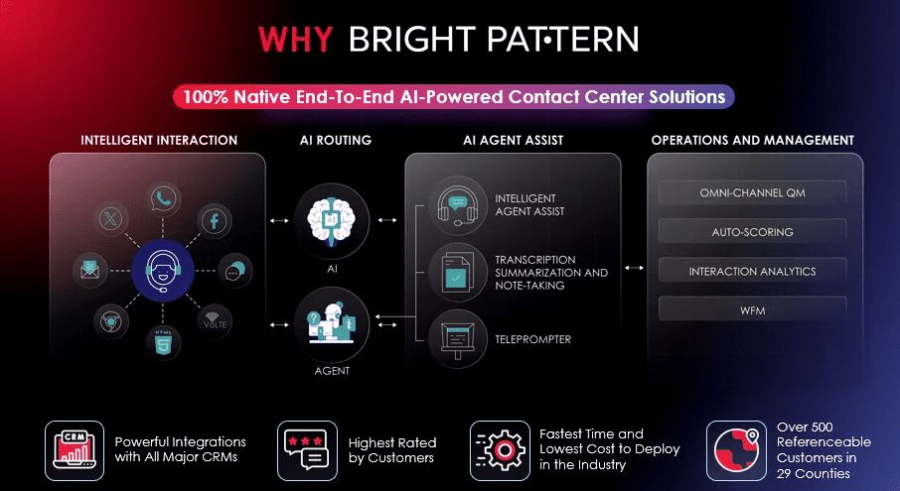
Bright Pattern’s AI contact center solutions help organizations respond faster, resolve issues more efficiently, and deliver personalized service that improves customer satisfaction and loyalty.
2. Genesys
Genesys provides AI-driven contact center solutions focused on delivering intelligent routing, automated self-service, and predictive analytics to enhance customer interactions across multiple channels.
3. Five9
Five9’s cloud contact center platform leverages AI to improve agent productivity, streamline operations, and offer personalized experiences through advanced speech recognition and predictive dialing.
4. NICE inContact
NICE inContact combines AI, analytics, and workforce optimization to create an adaptable contact center platform that enhances agent performance and customer engagement.
5. Talkdesk
Talkdesk offers an AI-powered contact center solution with features like automated workflows, intelligent routing, and machine learning-driven insights to improve overall service quality.
6. Cisco Contact Center
Cisco’s AI-enabled contact center solutions focus on intelligent automation, cloud scalability, and data-driven insights to enhance both agent and customer experience.
7. Avaya
Avaya provides AI-driven communication solutions that integrate voice, chat, and digital channels, helping businesses streamline operations and deliver personalized customer service.
8. Zendesk
Zendesk’s contact center platform leverages AI to provide predictive support, automated ticketing, and performance analytics for better customer engagement.
9. RingCentral
RingCentral integrates AI features like chatbots, sentiment analysis, and workflow automation to improve efficiency and customer satisfaction in cloud-based contact centers.
10. 8x8
8x8 offers AI-enhanced contact center solutions focused on omnichannel communication, real-time analytics, and automation tools to increase agent productivity and customer experience.
What Is AI in the Contact Center?
AI in the contact centerrefers to a set of technologies that use data, automation, and machine learning to understand customer needs, streamline interactions, and support agents in real time. Rather than replacing people, AI augments human capabilities, taking care of repetitive work and surfacing insights so agents can focus on high-value conversations.
Common AI capabilities in modern contact centers include:
- Conversational AIthat powers chatbots and virtual assistants.
- Voicebotsthat handle or triage calls using natural language understanding.
- Agent-assist toolsthat suggest responses, next best actions, and knowledge articles.
- Predictive analyticsthat anticipate customer needs and route interactions intelligently.
- Speech and text analyticsthat analyze interactions at scale to surface trends and opportunities.
The result is a smarter, more responsive operation where every interaction is faster, more accurate, and more personalized.
Why AI Is Transforming Contact Centers Now
AI has existed for years, but several recent shifts make it especially powerful and practical in contact centers today:
- Explosion of customer datafrom calls, chats, email, social media, and apps, giving AI models rich context to learn from.
- Advances in natural language processingthat allow AI to understand everyday human language, not just simple keywords or menu choices.
- Cloud-based platformsthat make AI features more accessible and easier to integrate into existing contact center infrastructure.
- Rising customer expectationsfor fast, convenient, 24/7 support on their channel of choice.
- Pressure to optimize costswhile still improving service quality and agent experience.
These forces combine to make AI one of the highest-impact levers for contact center leaders who want to improve both customer experience and operational efficiency.
Key AI Technologies Powering Modern Contact Centers
AI in the contact center is not a single tool. It is an ecosystem of technologies that work together. Understanding the main components helps you identify which use cases will create the most value for your organization.
Conversational AI and Chatbots
Conversational AIuses natural language understanding to interpret customer questions in chat or messaging channels and respond with relevant, human-like answers.
In the contact center, chatbots can:
- Resolve common queries instantly, such as password resets, order status, or account balances.
- Walk customers through simple workflows, like booking appointments or updating personal details.
- Gather initial information before handing off to a live agent, reducing handle time.
- Offer 24/7 self-service, even when agents are offline.
When designed well, chatbots do not feel like rigid scripts. They recognize intent, handle natural phrasing, and know when to escalate gracefully to a human for more complex issues.
Voicebots and Speech Analytics
Voicebotsbring conversational AI to the phone channel, allowing customers to speak naturally instead of navigating long menu trees. Meanwhile,speech analyticsconverts calls into text and analyzes them at scale.
These capabilities enable outcomes such as:
- Shorter wait times by automating verification and routing at the start of the call.
- Consistent, policy-compliant handling of routine requests, like payment processing or balance inquiries.
- Insight into trending issues, product feedback, and sentiment across thousands of calls.
- Quality monitoring that evaluates every interaction, not just a small sample.
With real-time speech analytics, supervisors can even receive alerts about frustration or compliance risks as calls are happening, allowing immediate support.
Agent Assist and Knowledge AI
Agent assisttools use AI to support human agents during live interactions. They listen to or read the conversation and surface relevant content in real time.
Agent assist can:
- Suggest the most likely answers from a knowledge base as the customer speaks or types.
- Auto-populate forms and after-call notes, reducing repetitive admin work.
- Provide guidance on next best actions, upsell opportunities, or required disclosures.
- Offer prompts for empathetic language and de-escalation techniques.
This turns every agent, including new hires, into a more confident, high-performing problem solver while shortening onboarding times and ensuring consistent service quality.
Predictive Routing and Workforce Optimization
Predictive routinguses AI to analyze both customers and agents and match them intelligently. Instead of routing by simple queues or skills, AI looks at factors such as past interactions, preferences, sentiment, and agent performance patterns.
This unlocks benefits including:
- Higher first-contact resolution by pairing each customer with the best-fit agent or self-service path.
- Better conversion rates on sales and retention calls.
- More balanced workloads aligned with agent strengths and development goals.
Workforce optimization (WFO)tools also rely on AI to forecast volume, schedule staff, and identify coaching opportunities. This keeps service levels strong while controlling labor costs.
Top Business Benefits of AI-Driven Contact Centers
When you bring these technologies together with the right strategy, the impact is felt across customer experience, operational efficiency, and revenue growth.
1. Faster, More Convenient Customer Service
- Instant answers 24/7via bots and virtual assistants reduce wait times and abandoned contacts.
- Omnichannel supportlets customers move between chat, voice, and email without repeating themselves.
- Smart self-servicesolves straightforward issues quickly, reserving agents for complex needs.
The overall effect is a smoother experience that meets modern expectations for speed and ease.
2. Higher Agent Productivity and Engagement
- Reduced manual workthanks to automated note-taking, data entry, and call summaries.
- Less cognitive loadas AI surfaces the right information instead of agents hunting through multiple systems.
- Faster onboardingbecause new agents are guided in real time by agent-assist tools.
- More meaningful workwith repetitive tasks handled by bots, leaving agents to solve problems and build relationships.
When agents feel supported and able to succeed, burnout drops and retention improves, which further stabilizes service quality.
3. Improved First-Contact Resolution and Quality
- Context-aware routingsends customers to the best resource the first time.
- Real-time coachinghelps agents de-escalate and resolve complex situations more effectively.
- Comprehensive analyticsreveal root causes of repeated contacts so processes and products can be improved.
Higher first-contact resolution not only delights customers; it also reduces overall interaction volume and costs.
4. Data-Driven Decisions Across the Business
Speech and text analytics turn thousands or millions of interactions into a rich source of insight. Business leaders can use this data to:
- Spot recurring pain points in products, policies, or digital journeys.
- Identify upsell and cross-sell opportunities customers naturally ask about.
- Measure the impact of new campaigns or offers through customer reactions in real time.
- Prioritize improvements based on what matters most to customers, not just internal assumptions.
The contact center becomes a strategic feedback engine, not just a cost line.
5. Measurable Cost Savings and Revenue Uplift
AI delivers tangible financial benefits, including:
- Lower cost per contactthrough automation of routine tasks and more efficient handling of complex ones.
- Reduced training and ramp-up timeas intelligent guidance shortens time to proficiency.
- Higher conversion and retention rateswhen predictive routing and guidance support sales and loyalty conversations.
- Better utilization of resourcesthanks to accurate forecasting and scheduling.
These gains add up, turning the contact center into a powerful lever for profitability.
AI Use Cases Across the Customer Journey
AI can add value at every stage of the customer lifecycle, from acquisition to renewal and advocacy. Below are representative use cases that many organizations start with.
Pre-Sales and Acquisition
- Lead qualification chatbotsthat capture intent, gather key details, and route hot prospects to sales agents.
- Proactive outreachwhen AI predicts a customer might need help completing a purchase or onboarding.
- Personalized recommendationsduring conversations based on similar customers or past behavior.
Onboarding and Adoption
- Guided setup assistantsthat walk new customers through configuration, reducing early-stage confusion.
- In-app support botsthat answer questions without forcing customers to leave the product or channel they are using.
- Proactive check-inswhen usage patterns suggest a customer might be stuck.
Support and Service
- Self-service resolutionof common issues through chatbots and voicebots.
- Smart triagethat prioritizes urgent or high-value cases for faster human support.
- Real-time translationsupporting multilingual interactions without needing a large number of language-specific agents.
- Agent guidancethat ensures consistent, compliant responses across the team.
Loyalty, Retention, and Growth
- Churn prediction modelsthat flag at-risk customers so agents can intervene with targeted offers or support.
- Upsell promptswhen customer behavior or context indicates openness to additional products or services.
- Feedback analysisfrom surveys, reviews, and conversations to fuel continuous improvement initiatives.
How AI Supports — Not Replaces — Human Agents
A common misconception is that AI in the contact center is primarily about replacing people. In practice, the most successful programs focus onaugmentinghuman agents, not eliminating them.
When implemented thoughtfully, AI:
- Handles repetitive workso agents can focus on complex, emotional, or high-value interactions.
- Reduces stressby offering guidance during tough conversations and managing routine tasks in the background.
- Improves career developmentby surfacing coaching opportunities and helping agents build skills more quickly.
- Elevates the roleof contact center staff from order-takers to trusted advisors and problem-solvers.
The human element remains essential for empathy, judgment, and relationship-building. AI simply gives agents more time and better tools to excel at those uniquely human strengths.
Implementing AI in Your Contact Center: A Practical Roadmap
To capture the full value of AI, it is important to move beyond isolated experiments and build a clear, phased roadmap. Below is a high-level approach many organizations follow.
1. Define Business Goals and Success Metrics
Start with outcomes, not technology. Clarify what you want AI to achieve, such as:
- Reducing average handle time.
- Improving first-contact resolution.
- Boosting customer satisfaction or net promoter scores.
- Lowering cost per contact.
- Increasing sales conversion or retention rates.
Clear goals guide which AI capabilities to prioritize and how to measure progress.
2. Map Customer Journeys and Identify High-Impact Use Cases
Map out your key customer journeys and identify where friction, delays, or high volumes exist. Typical high-impact starting points include:
- Frequently asked questions with simple, rule-based answers.
- Repetitive agent tasks such as authentication, note-taking, or case categorization.
- Overflow periods where wait times spike and service levels dip.
Prioritize use cases that are low-risk, easy to implement, and aligned with your business goals.
3. Ensure Data Quality and Integration
AI depends on accurate, accessible data. Before scaling, focus on:
- Consolidating customer datafrom relevant systems so AI has a complete view of each interaction.
- Standardizing categories and labelsfor contacts to improve training data quality.
- Integrating AI toolswith your contact center platform, CRM, and knowledge base.
Good data foundations make AI more accurate, reliable, and valuable.
4. Pilot, Learn, and Iterate
Launch AI capabilities in controlled pilots before broad rollout. For each pilot:
- Define a specific goal and baseline metrics.
- Involve frontline agents and supervisors early to gather feedback.
- Monitor performance, customer satisfaction, and escalation patterns closely.
- Refine conversation flows, routing rules, and knowledge content based on real-world results.
This iterative approach builds trust and ensures that AI deployments deliver tangible improvements.
5. Engage and Support Your People
The human side of AI transformation is as important as the technology. Success depends on:
- Transparent communicationabout why AI is being introduced and how it will help agents.
- Training and enablementso agents know how to work with new tools effectively.
- Feedback loopsthat allow staff to share ideas and identify additional opportunities for automation and support.
When agents see AI as a partner rather than a threat, adoption soars and performance follows.
6. Scale and Optimize Continuously
Once pilots prove successful, you can expand AI usage to more journeys, channels, and regions. Continue to:
- Refine models using fresh interaction data.
- Update knowledge content regularly so AI answers remain accurate.
- Align AI initiatives with broader customer experience and digital transformation strategies.
AI is not a one-time project but an ongoing capability that grows more valuable as it learns.
Key Metrics and KPIs for AI-Powered Contact Centers
To demonstrate the impact of AI, you will want a clear measurement framework. Common metrics include:
Customer Experience Metrics
- Customer satisfaction (CSAT)scores after interactions with bots and agents.
- Net promoter score (NPS)to gauge loyalty over time.
- Customer effort score (CES)to measure how easy it is to get issues resolved.
- First-contact resolution rateacross all channels.
Operational Metrics
- Average handle time (AHT)for both agents and self-service interactions.
- Containment ratefor chatbots and voicebots (issues resolved without human escalation).
- Service leveland average speed of answer.
- Cost per contactand overall interaction volume by channel.
Agent Experience and Performance Metrics
- Agent satisfaction and engagementsurvey results.
- Time to proficiencyfor new hires.
- Quality scoresbased on 100 percent interaction monitoring with speech and text analytics.
- Turnover and absenteeismrates.
Revenue and Strategic Impact Metrics
- Sales conversion ratesin AI-supported interactions.
- Upsell and cross-sell revenuelinked to AI prompts and recommendations.
- Churn rateand retention improvements for at-risk segments.
- Insights implementedfrom analytics, such as product fixes or policy changes.
By tracking these metrics before and after AI implementation, you can clearly articulate its contribution to customer experience, efficiency, and growth.
Future Trends in AI for Contact Centers
AI is evolving quickly, and several trends are shaping the next generation of contact center capabilities.
Generative AI for Richer Interactions
Generative AIcan create natural, context-aware responses, summaries, and knowledge content. In the contact center, this means:
- More human-like virtual agents that can handle multi-step dialogues.
- Automatic drafting of emails, case summaries, and follow-up messages for agents.
- Rapid creation and updating of knowledge base articles from real interactions.
Deeper Personalization
As AI systems integrate more contextual data, personalization will move beyond using a customer’s name. Future-ready contact centers will be able to:
- Recognize returning customers across channels and remember preferences.
- Tailor offers, resolutions, and communication styles to individual needs.
- Predict needs before customers reach out and offer proactive support.
Stronger Collaboration Across the Enterprise
The insights generated in the contact center are increasingly shared across marketing, product, and operations teams. AI will strengthen this collaboration by:
- Automatically flagging emerging issues to product teams.
- Highlighting winning messages for marketing to amplify.
- Surfacing process bottlenecks for operations to streamline.
The result is a more connected organization that responds faster to customer needs.
Conclusion: Turning Your Contact Center into a Competitive Advantage with AI
Artificial intelligence is no longer a futuristic concept for contact centers; it is a practical toolkit for transforming customer experience, empowering agents, and driving profitable growth.
By combining conversational AI, intelligent routing, real-time analytics, and agent assist, organizations can deliver faster, more personalized support while optimizing costs and unlocking new revenue opportunities.
The most successful AI strategies start with clear goals, focus on high-impact use cases, and prioritize the people who bring each interaction to life. With that foundation, AI becomes a powerful ally that turns your contact center from a perceived cost center into a true engine of customer loyalty and business growth.
